 |
|
|
|
|
Acoustical
Barriers to Learning: Children at Risk in Every Classroom
|
|
|
Peggy
B. Nelson
|
|
|
University
of Maryland School of Medicine, Baltimore 1
|
|
|
Sig
Soli
|
|
|
House
Ear Institute, Los Angeles, CA
|
ABSTRACT: There are surprisingly large numbers of children with various auditory disorders in the schools. Their classrooms are often noisy, reverberant, and active places of learning. For these children, their auditory problems plus the poor classroom acoustics cause significant learning problems. Poor listening conditions can affect all children, but they affect those with auditory disorders more. Improving classroom acoustics can significantly reduce the negative educational impact of auditory disorders. This article reviews relevant literature on acoustical barriers to successful learning and provides guidance for school personnel making desisions regarding classroom facilities.
Keywords: classroom acoustics, children with hearing loss
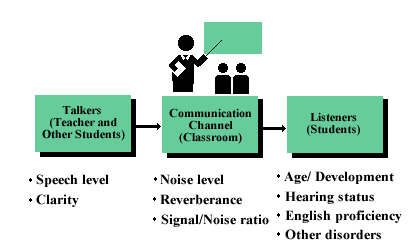
All children need good, clear signals and low background noise ( good signal-to-noise ratio (SNR) for full understanding. Improving classroom acoustics is important for all children in schools, particularly for young children in the early grades. Communication in classrooms often occurs in less than ideal acoustic conditions, and is complicated by multiple talkers, noisy rooms, reverberant walls, and inexperienced listeners (Figure 1). This acoustical complexity confounds the instruction of young students, children learning English as a second language, and children with otitis media (OM) or minimal hearing loss. The presence of noise and/or reverberation in classrooms increases the complexity of educating children who are at risk. The purpose of this article is to review the relevant findings from recent literature and to provide a rationale for the classroom acoustics standards that are in process.
| Figure 1. Model of classroom communication, including the talkers, the potential barriers in the communication channel, and the constraints on listeners. |
|
|
 |
|
|
RELEVANT FINDINGS
Children at Risk
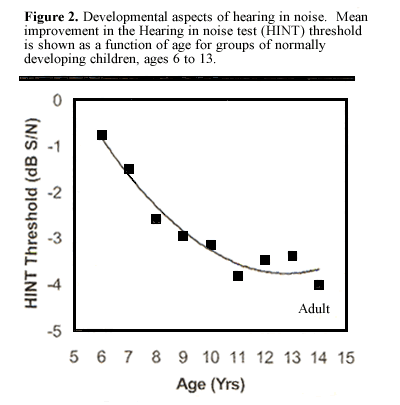
Young listeners. Numerous studies have demonstrated that young listeners perform more poorly in noisy situations than do adults. Soli and Sullivan (1997) reported that the ability to listen in noise is not completely developed until a child reaches adolescence. They studied children using the Hearing in Noise Test (HINT, Nilsson, Soli & Sullivan, 1994) and determined that children's ability to understand sentences in noise improves through the early childhood years, reaching adult performance levels during the teen years (Figure 2).
Stelmachowicz, Hoover, Lewis, Kortekaas, & Pittman (2000) reported similar results. They studied typically developing children aged 5-7 years, presenting words with differing amounts of background noise, thus varying the audibility of the words. At high audibility levels (that is, low noise levels), both children and adults understood virtually all of the words. At low audibility (high noise) levels, adults could understand the majority of the words, but children understood very little. Similarly, Elliott (1979) studied 9- to 17-year-old children's recognition of high and low predictability sentences in noise. The performance of 9-year-olds was significantly poorer than that of 11-year-olds, who also performed significantly poorer than 15- and 17-year-olds. Gravel, Fausel, Liskow, and Chobot (1999) reported on children's speech recognition abilities for words and sentences presented in background noise when the children used omnidirectional and dual-microphone hearing aid technology. Consistent with previous reports, they found that younger children (4 to 6 years of age) with bilateral cochlear hearing loss required a more advantageous SNR to reach the same performance levels as older children (7 to 11 years of age).
The evidence presented in these studies overwhelmingly suggests that young children are less sophisticated listeners in background noise than are older children and adults. Young children therefore can be expected to require a more advantageous acoustic environment for full understanding, and correspondingly, they are at risk for reduced learning in a noisy or reverberant classroom.
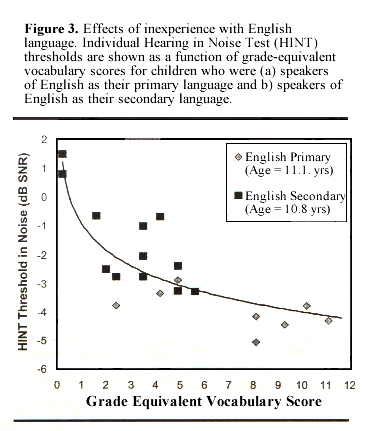
Children learning English as a second language. A second at-risk group consists of children who are learning English as a second language. The ability to understand spoken English in noise is also related to the listener's proficiency and experience with the English language (Nilsson, Gellnet, Sullivan, & Soli, 1992) (Figure 3). Eleven-year-old children who were speakers of other languages performed significantly more poorly than did age-matched children who were native speakers of English on the HINT (Gelnett, Sumida, & Soli, 1994). This difference was apparent between groups even when children were matched for their single-word vocabulary scores. Thus, children who are less experienced with English require more favorable conditions for understanding classroom conversations.
Children with hearing loss. Still another special group of children in our schools includes children with hearing loss. These children are also at great risk for the detrimental effects of poor classroom acoustics ( see Crandall & Smaldino, this issue). The evidence below suggests that hearing loss is very prevalent among schoolchildren.
Children with OM. OM is a temporary, recurring middle ear infection that is often accompanied by the presence of fluid in the middle ear (effusion). The incidence of OM among children is at an all-time high, doubling between 1975 and 1990 (Schappert, 1992). It is the most common medical diagnosis for children, accounting for 6 million office visits in 1990 for children between the ages of 5-15 years (Stoll & Fink, 1996). It is estimated that, within a hypothetical group of 100 children under the age of 5 years, there will be 70 bouts of OM annually. Twenty-five more bouts are presumed invisible and uncounted. Only half of the bouts of OM clear within a month, whether treated or not. During that month (or more), the child's hearing loss fluctuates, varying between 0 to 40 dB (normal to mild hearin loss). One can easily do the math and figure that for 30 children in a Grade 1 class, there will be 20 bouts of OM over the course of the year, averaging 3-4 weeks each. It can be expected that every week, there are children with hearing loss due to OM in the earlier grades.
Children with minimal hearing loss. Two recent studies have uncovered surprising numbers of children with slight, or minimal, hearing loss. Niskar et al. (1998) from the Centers for Disease Control in Atlanta studied 6,000 children and adolescents, ages 6-19 years. They found that a surprising 15% of these students had a hearing loss of at least 16 dB. Of these, 7% had low-frequency hearing loss and 13% had high-frequency loss (some children had both).
Bess, Dodd-Murphy, and Parker (1998) found a similar incidence of minimal hearing loss, with major educational consequences. They studied 1,200 children in Tennessee, of whom 13% had slight (15 dB HL or greater) hearing loss. Notably, 37% of the children with slight hearing loss had repeated at least one grade in school, compared to only 3% of the control group of matched peers. The children with slight hearing loss wre usually unaware of their loss, yet they exhibited significantly greater dysfunction than children with normal hearing on several tests of behavior, energy, stress, social support, and self-esteem. Among the younger children, there were large communication differences between those children with and without hearing loss. Third-grade children with slight hearing loss exhibited significantly lower scores than matched peers with normal hearing on a series of academic achievement subtests.
A significant number of children with hearing loss can be found in every school. Most of these children have mild or slight hearing losses that often go unrecognized by students, parents, and teachers. Nevertheless, these children require very favorable SNRs for good understanding, and are clearly suffering in current classroom conditions. It is these children who need improved acoustics to hear and understand the teacher and their peers.
Noisy and Reverberant Classrooms
Classrooms are generally noisy places and seem more active than in past decades. For example, recent trends suggest that learning often involves "collaborative interactions of multiple minds and tools as much as individual possession of information" (Wolf, Bixby, Glenn, & Gardner, 1991, p. 49).
Recent findings on the noise conditions of unoccupied classrooms also suggest that most classrooms are not sufficiently quiet for maximum understanding by all students. Knecht, Nelson, Whitelaw, and Feth (in press) measured reverberation and background noise levels in 32 unoccupied elementary classrooms in eight public school buildings in Central Ohio. Of the 32 classrooms assessed in this study, only four had background noise levels below the recommended 30 dBA established by the American Speech-Language-Hearing Association (ASHA, 1995). Background noise levels for most of the 32 classrooms wre 10-15 dB higher than recommended. Although the noisiest classrooms were those with noisy heating, ventilating, and air-conditioning (HVAC) units running, most of the classrooms exceeded the ASHA-recommended noise criterion even when the HVAC systems were turned off. Noise from other internal equipment, outside hallways, and outdoors added to the total noise measured inside the rooms. Arguably, quiet (35 dBA) classrooms are currently rare, and school systems will experience some additional cost to ensure good classroom SNR.
SNR Effects. A large body of evidence suggests that adults can understand familiar spoken material at SNR levels of approximately 0 dB, that is, when the signal and noise are of the same strength (Nilsson, Soli, & Sullivan, 1994). Young children require conditions that are more favorable by a few dB (e.g. +4 dB SNR). Those unfamiliar with the instructional language require a few dB more (e.g., +7 dB SNR). The many children with hearing loss require yet a few dB more (e.g. +12 dB SNR). In a reverberant environment, to be discussed next, children, especially those with hearing loss, will require even more favorable SNR.
In sum, the literature has demonstrated that, if an acoustic environment can be provided that allows +15 dB SNR throughout the entire classroom, then all participants can hear well enough to receive the spoken message fully. Additional evidence suggests that classrooms that maintain ambient noise levels of 35 dBA or less will allow speakers voices to reach all listeners at the desired +15 dB SNR. This is a challenging goal, but it is the goal for all classrooms.
Reverberation effects. Sound reverberation in classrooms with hard walls and high ceilings "smears" the temporal properties of sppeech signals, making them more difficult to understand. Room reverberation is measured in terms of the time required fo the sound of a brief signal to be reduced by 60 dB (reverberation time [RT] or RT60). In highly reverberant (RT > 1 second) rooms, such as in a cathedral or large hall, an audible echo is present and speech understanding is diminished. Favorable RTs for understanding speech range from 0.2 to 0.6 second.
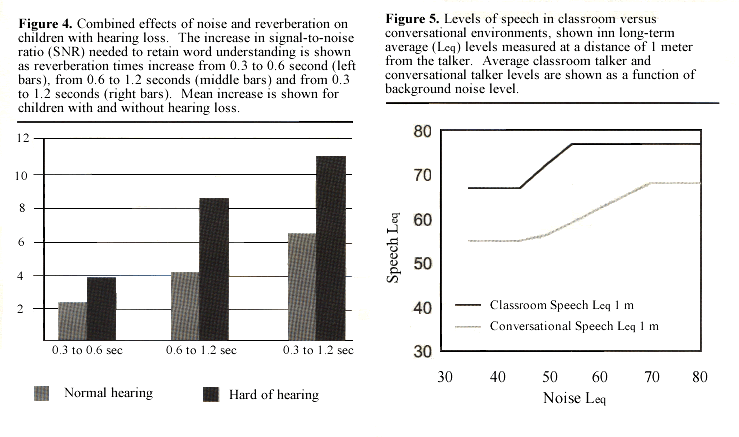
There is evidence that children with hearing loss need more favorable SNRs when rooms are highly reverberant than when rooms have favorable RTs. Hawkins (1986) studied children with and without hearing loss for the increase in SNR needed to maintain word recognition at a fixed level as reverberation increased (see Figure 4). Children with normal hearing required 4 dB more favorable SNR to maintain word understanding when reverberation increased from favorable RTs (0.3 sec) to poor RTs (1.2 sec). Children with hearing loss required a much larger increase in SNR to (>7 dB) to maintain word understanding in reverberant rooms. Thus, children with hearing loss experience a compounding effect of noise and reverberation. In reverberant rooms, they require lower levels of background noise than do children with normal hearing.
RT measurements for the 32 classrooms in the Knecht et al. (in press) study ranged from 0.2 to 1.27 seconds. Only six of the 32 unoccupied classrooms met the ASHA criterion of 0.4 second RT or less. The combined result of the observed noise levels and RTs is that teachers' voices are often reaching students at unacceptably low SNRs, and the undesirable reverberation further confounds intelligibility.
Teachers can (and do) use strong vocal levels and roaming tactics to ensure that their voices are heard by all children in noisy and reverberant rooms. As seen in Figure 5, teachers clearly raise their voices louder than typical conversation levels in the presence of the same background noise. However, when noise levels exceed approximately 55 dBA, teachers are unable to raise their voices sufficiently for all to hear.
Educational Effects
Students who do not have full access to spoken information in classrooms either from their teacher or from peers cannot be expected to learn at a normal rate. The literature demonstrates clearly that even a slight hearing loss is often accompanied by delayed acquisition of vocabulary, reduced incidental learning, frequent significant academic delay, and limited reading abilities (Ross, 1990). However, recent evidence of the effects of early intervention (Yoshinaga-Itano, Sedey, Coulter, & Mehl, 1998) suggests that none of these deficits is a necessary consequence of hearing loss. They are consequences, rather, of reduced communication opportunities between the child with hearing loss and the rich communicative environment. Clearly, if the barriers to communication can be overcome, then we can facilitate more normal learning for the child with hearing loss.
Classroom noise from HVAC systems and other noise sources causes multiple significant teaching/learning problems, including teacher vocal fatigue and students' off-task behavior. These consequences, along with the learning deficits experienced by students in noisy rooms, are the costs of the current situation. To make a cost-effective difference in classroom acoustics, school administrators need a cluster of solutions from an interdisciplinary team of professionals. Although classroom sound field amplification systems can help significantly (see Smaldino & Crandell, this issue, and Eriks-Brophy & Ayukawa, this issue), they are only a parial solution. Adding amplified sound through speakers into an already noisy and reverberant room can cause additional problems without providing significant improvements in SNR. When high levels of noise are already present in a classroom, amplified sound levels may need to exceed 85 dB sound pressure level in order to achieve +15 dB SNR throughout the room. High levels such as this can be annoying and can easily spill over into adjacent rooms where walls and doors provide inadequate sound barriers. Introducing these high levels into a reverberant room can result in unexpected increases in sound level due to the reflections from walls, floors, and ceilings. The room becomes significantly louder than before, and chidlren raise their voices to be heard by their peers. Schools need first to address classroom noise and reverberation solutions through quiet HVAC systems and room architectural changes, such as those suggested in Siebein, Gold, Siebein, and Ermann (this issue).
The U.S. Access Board (1998) has recently recognized the overwhelming evidence for the need for improved classroom acoustics, and they have become actively involved in this effort (see Sorkin, this issue). They have charged the mulitdisciplinary Classroom Acoustics Working Group with developing a new ANSI standard that may become the benchmark for new classroom instruction.
SUMMARY
Acoustical requirements for children in schools exceed those for adults, based on their developmental status, hearing status, and language proficiency. Recommended classroom acoustics for successful speech understanding can be achieved by restricting classroom noise levels to approximately 35 dBA and RTs to 0.4-0.6 seconds, resulting in the desired SNR ratio of +15 dB throughout the room. Field measurements demonstrate that these requirements are not often met, primarily due to HVAC noise, external noise from adjacent rooms and the outside, and self-generated noise from students. The educational impact of excessive classroom noise levels is substantial, especially in our multilingual culture.
There are children in every class, especially in the early grades, who cannot hear or understand the spoken message well. This has a very significant impact on learning and attention, especially learning to read. Classroom noise and reverberation compound the problem. We need creative inventive solutions, including amplification, architectural changes, and HVAC changes for better listening conditions. These solutions will come at some added expense now, but ultimately will prove to be a smart investment.
American Speech-Language Hearing Association. (1995, March). Position statement and guidelines for acoustics in educational settings. Asha, 37 (Suppl. 14), 15.
Bess, F.H., Dodd-Murphy, J., & Parker, R.A. (1998). Children with minimal sensorineural hearing loss. Ear and Hearing, 19(5), 339-354.
Crandell, C., & Smaldino, J. (2000). Classroom acoustics for children with normal hearing and with hearing impairment. Language, Speech, and Hearing Services in Schools, 31, 362-370.
Elliott, L.L. (1979). Performance of children aged 9 to 17 years on a test of speech intelligibility in noise using sentence material with controlled word predictability. Journal of the Acoustical Society of America, 66(3), 651-653.
Eriks-Brophy, A., & Ayukawa, H. (2000). The benefits of sound field amplification in classroom of Inuit students of Nunavik: A pilot project. Language, Speech, and Hearing Services in Schools, 31, 324-335.
Gelnett, D., Sumida, A., & Soli, S.D. (1994,April). The development of the Hearing in Noise In Noise Test for Children (HINT-C). Paper presented at the annual convention of the American Academy of Audiology, Richmond, VA.
Gravel, J.S., Fausel, N., Liskow, C., & Chobot, J. (1999). Children's speech recognition in noise using omni-directional and dual-microphone hearing aid technology. Ear and Hearing. 20(1), 1-11.
Hawkins, D. (1986). Options in classroom amplification systems. In F. Bess (Ed.), Hearing impairment in children (pp. 253-265). Baltimore, MD: York Press.
Knecht, H., Nelson, P., Whitelaw, G. and Feth, L. (in press). Structural variables and their relationship to background noise levels and reverberation times in unoccupied classrooms. American Journal of Audiology.
Nilsson, M.J., Gellnet, D., Sullivan, J., & Soli, S.D. (1992). Norms for the Hearing in Noise Test: The influence of spatial separation, hearing loss, and English language experience on speech reception thresholds. Journal of the Acoustical Society of America, 92, S2385.
Nilsson, M., Soli, S.D., & Sullivan, J. (1994). Development of the Hearing In Noise Test for the measurement of speech reception thresholds in quiet and in noise. Journal of the Acoustical Society of America, 95, 1085-1099.
Niskar, A.S., Kieszak, S.M., Holmes, A., Esteban, E., Ruben, C., & Brody, D.J. (1998) Prevalence of hearing loss among children 6 to 19 years of age, Journal of the American Medical Association, 279 (14), 1071-1075.
Ross, M. (1990). Definitions and descriptions. In J. Davis (Ed.), Our forgotten children: Hard-of-hearing pupils in the schools (pp. 3-17). Washington, DC: U.S. Department of Education.
Schappert, S. (1992). Office visits for otitis media: United States, 1975-1990. Advance Data from Vital and Health Statistics, 214, 1-15.
Siebein, G., Gold, M., Siebein, G., & Ermann, M.G. (2000). Ten ways to provide a high-quality acoustical environment in schools. Language, Speech, and Hearing Services in Schools, 31, 376-384.
Smaldino, J., & Crandell, C. (2000). Classroom amplification technology: Theory and practice. Language, Speech, and Hearing Services in Schools, 31, 371-375.
Soli, S.D., & Sullivan, J.A. (1997). Factors affecting children's speech communication in classrooms. Journal of the Acoustical Society of America, 101, S3070.
Sorkin, D. (2000). The classroom acoustical environment and the Americans with Disabilities Act. Language, Speech, and Hearing Services in Schools, 31, 385-388.
Stelmachowicz, P.G., Hoover, B.M., Lewis, D.E., Kortekaas, R., & Pittman, A.L. (2000). The relation between stimulus context, speech audibility, and perception for normal-hearing and hearing-impaired children. Journal of Speech, Language, and Hearing Research, 43, 902-914.
Stoll, L., & Fink, D. (1996). Changing our schools: Linking school effectiveness and school improvement. Buckingham, England: Open University Press.
United States Access Board. (1998). Request for information on classroom acoustics [On-line]. Available: www.access-board.gov/rules/acoustic.htm.
Wolf, D., Bixby, J., Glenn, J., & Gardner, H. (1991). To use their minds well: Investigating new forms of student assessment. Review of Research in Education, 17, 31-74.
Yoshinaga-Itano, C., Sedey, A.L., Coulter, D.K., & Mehl, A.L. (1998). Language of early- and later-identified children with hearing loss. Pediatrics, 102(5) 1161-1171.
Contact author: Peggy B. Nelson, University, Department of Communication Disorders, 164 Pillsbury Drive SE, Minneapolis, MN 55455. E-mail: nelso477@tc.umn.edu